
Finding the best hunting e-bikes under $2,000 starts with your route, not the biggest motor number. You need enough battery for the return trip, a frame that fits, and a practical way to carry your equipment. Getting the bike to your hunting area matters, too.
For an initial shortlist, compare the Lectric XPeak 2.0 and Mokwheel Basalt 2.0 if you want a hardtail. If rear suspension is a priority, consider the PUCKIPUPPY Labrador Pro and Boxer; if folding storage would solve a transport problem, look at the Heybike Ranger 3.0 Pro. The individual recommendations below explain those choices in more detail.
These are research-based recommendations using published manufacturer specifications, not a head-to-head field test. We focus on hunting access and carrying equipment within stated limits. Inclusion does not mean a bike is suitable for technical trails, heavy towing, or every route where you hunt.
The Shortlist: 7 Hunting E-Bikes Under $2,000
The main choice is where to put your money: a larger battery, rear suspension, folding storage, or a more adjustable riding setup.
| Model | Listed Price | Standard Battery | Listed Weight | Main Buying Reason | Main Limitation |
|---|---|---|---|---|---|
| Lectric XPeak 2.0 | $1,499 | 720Wh | 75 lb with battery | Torque sensing and an 8-speed drivetrain below the budget ceiling | No rear suspension; 330 lb total payload. |
| Mokwheel Basalt 2.0 | $1,699.99 | Approx. 940Wh | 80 lb | Larger battery in a hardtail configuration | High-step frame has a 30-inch standover height. |
| PUCKIPUPPY Labrador Pro | $1,599.99 | 960Wh* | 85.7 lb | Full suspension with torque-sensing assistance | Substantial weight for loading and transport. |
| Heybike Ranger 3.0 Pro | $1,399 | 720Wh | 75 lb | Folding frame, full suspension, and a 100 lb-rated rear rack | Folding does not reduce its lifting weight. |
| Velotric Nomad 2 | $1,999 | 705.6Wh | 75 lb | Switchable assist sensors and multiple frame-size options | Little budget remaining for tax or accessories. |
| PUCKIPUPPY Boxer | $1,399.99 | 960Wh* | 85.6 lb | Lower-priced full suspension with a large battery | Cadence sensing rather than torque sensing. |
| Fiido Titan Standard | $1,649 | 696Wh | 83.3 lb with battery | Integrated rear rack rated for 176 lb | Separate rider limit of 264 lb. |
Lectric XPeak 2.0 – Fat-Tire Hardtail E-Bike
At $1,499, the Lectric XPeak 2.0 offers room for equipment without sacrificing torque-sensing assistance, Shimano Altus 8-speed gearing, or hydraulic brakes. The standard configuration includes a 720Wh battery and 26×4-inch tires. Its brake setup uses a 203mm front rotor and a 180mm rear rotor.
An 80mm RST Renegade fork handles front suspension, but there is no rear shock. Lectric currently bundles a rack, fenders, and suspension seatpost with the bike. Before choosing this High-Step version, check the 29-inch standover height and whether its load limits leave enough allowance for your equipment.
Pros
- Torque sensing and an 8-speed drivetrain at $1,499.
- Hydraulic brakes with a 203mm front rotor.
- Removing the battery reduces lifting weight to 64.5 lb.
Cons
- No rear suspension.
Why We Recommend It
The Lectric XPeak 2.0 is a useful starting point if you want a hardtail without spending the full $2,000. Start here, then decide whether a larger battery or rear suspension is worth paying for. If your combined rider-and-gear weight approaches 330 lb, look elsewhere rather than trying to stretch the allowance.
Mokwheel Basalt 2.0 – Fat-Tire Hardtail E-Bike
The Mokwheel Basalt 2.0 costs $1,699.99 and includes a 48V 19.6Ah battery, which Mokwheel describes as approximately 940Wh. That is more standard battery capacity than the XPeak’s 720Wh configuration. Torque and cadence sensors, Shimano 8-speed gearing, and Tektro hydraulic brakes round out the main equipment.
Its 110mm adjustable fork offers more listed front travel than the XPeak, although suspension travel alone does not establish which bike handles better. Fit could settle the choice first: Mokwheel lists a 30-inch standover height and an 80 lb bike weight. The camouflage version costs another $100.
Pros
- Larger standard battery than several alternatives here.
- Torque-sensing assistance and a 110mm fork.
- Rack and fenders included in the current offer.
Cons
- No rear suspension.
- Tall high-step frame may not suit shorter riders.
Why We Recommend It
Put the Basalt on your shortlist if you would rather pay for battery capacity than a rear shock. Compared with the standard XPeak, the roughly $201 increase buys a larger battery and a different fork configuration. Neither guarantees better performance on your route, so check fit before letting capacity decide.
PUCKIPUPPY Labrador Pro – Full-Suspension Fat-Tire E-Bike
The PUCKIPUPPY Labrador Pro combines full suspension and torque-sensing assistance for $1,599.99. Its removable 48V 20Ah battery works out to 960Wh, while Shimano 8-speed gearing and 180mm hydraulic disc brakes complete the main specification. Camouflage costs $1,699.99.
For riders comparing budget hunting e-bikes, the useful distinction is the combination of rear suspension and assistance that responds to pedal pressure. PUCKIPUPPY lists a 110mm adjustable front fork but does not specify rear-wheel travel on the product page. Its 85.7 lb listed weight also deserves attention if you normally load your bike alone.
Pros
- Full suspension with torque sensing.
- A 960Wh nominal battery comes standard.
- Shimano 8-speed drivetrain.
Cons
- Heavy at a listed 85.7 lb.
Why We Recommend It
The Labrador Pro is worth the extra $200 over the Boxer if torque sensing matters to you. You also get an 8-speed drivetrain instead of seven speeds. If you mainly want rear suspension and do not need pedal-pressure-responsive assistance, the Boxer offers a less expensive alternative.
Heybike Ranger 3.0 Pro – Folding Full-Suspension E-Bike
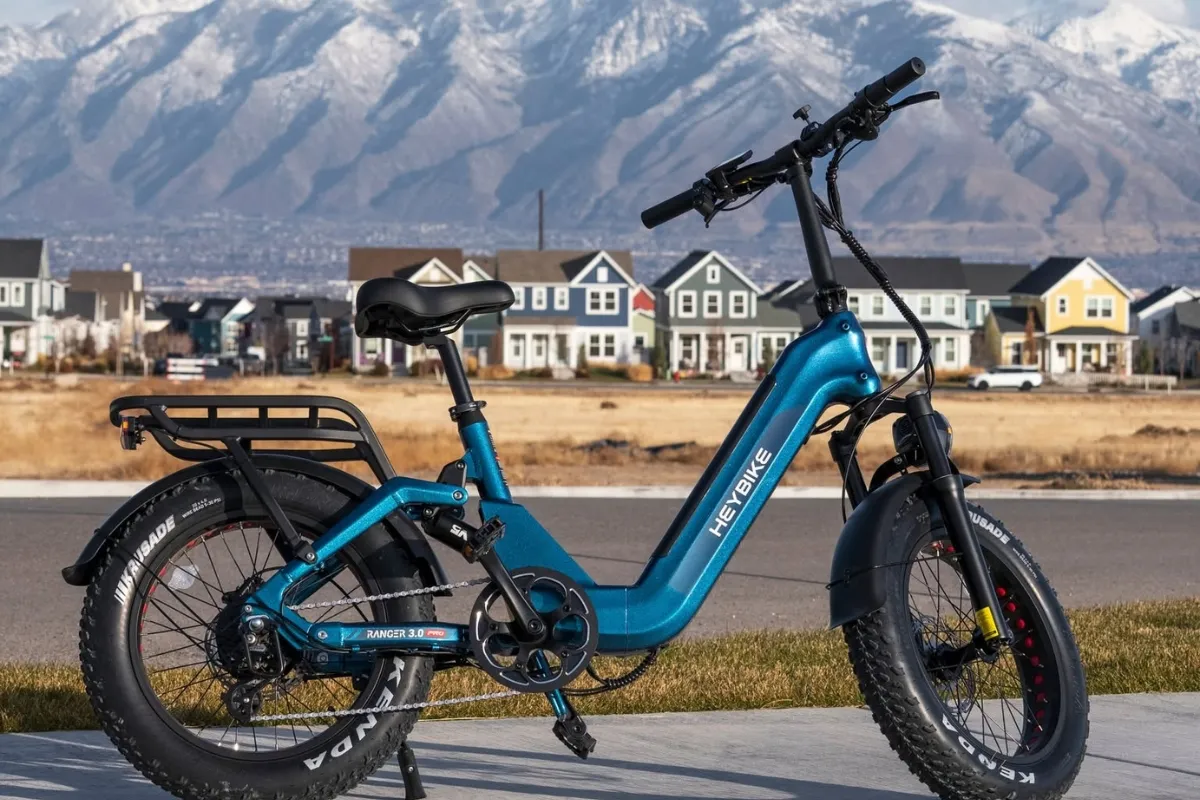
The $1,399 Ranger 3.0 Pro is the folding option in this comparison. Its step-through frame, 20×4-inch tires, and folded dimensions of 41.7×20.5×32.7 inches give you a different package from the larger-wheeled models. Measure your vehicle’s usable space before assuming it will fit inside.
You still get a 720Wh battery, torque sensing, Shimano Altus 8-speed gearing, and hydraulic brakes. Suspension consists of a 65mm front fork and an adjustable rear air shock. The included rack is rated for 100 lb, within the 440 lb combined rider-and-cargo allowance.
Pros
- Folding step-through frame.
- Full suspension and torque sensing.
- Included rear rack rated for 100 lb.
Cons
- Still weighs 75 lb.
- Folded dimensions require checking against your cargo space.
Why We Recommend It
Choose the Ranger when fitting the bike into your hunting-trip transport setup is a deciding factor. Its folding frame may remove the need to carry a full-length bike inside your vehicle, but only if the measurements work. Plan how you will lift it, not just where you will store it.
Velotric Nomad 2 – Fat-Tire Hardtail E-Bike
The Nomad 2 reaches the top of this budget at $1,999. Its clearest differences are SensorSwap, which switches between torque- and cadence-sensing assistance, and the availability of step-through and high-step frames in two sizes. Those options deserve consideration if fit or assist preference has ruled out other bikes.
Standard equipment includes a 705.6Wh battery, Shimano 8-speed drivetrain, 100mm suspension fork, and hydraulic brakes. A suspension seatpost, full fenders, and MIK HD-compatible rack are also included. The rack carries up to 66 lb; the published 505 lb overall load rating does not increase that rack limit.
Pros
- Switchable torque/cadence sensing.
- Multiple frame styles and sizes.
- Rack, fenders, and suspension seatpost included.
Cons
- No rear suspension.
Why We Recommend It
The Nomad makes more sense when you also want a bike for regular rides outside hunting season. Its frame choices and adjustable assistance distinguish it from simply buying more battery or suspension. If those options do not solve a problem for you, the less expensive models leave more money for your setup.
PUCKIPUPPY Boxer – Full-Suspension Fat-Tire E-Bike
The Boxer costs $1,399.99, saving $200 compared with the Labrador Pro. It retains full suspension, a 48V 20Ah battery, and 180mm hydraulic brakes. The main changes are cadence sensing and a Shimano 7-speed drivetrain.
Its front fork has 130mm of listed travel, paired with PUCKIPUPPY’s cage-style rear suspension. Do not choose between the two models on front travel alone. The Boxer’s 30-inch standover height is also higher than the Labrador Pro’s listed 28.6 inches, while their published weights are nearly identical.
Pros
- Full suspension and a 960Wh nominal battery at $1,399.99.
- Hydraulic brakes.
- Saves $200 over the Labrador Pro.
Cons
- Cadence sensing only.
- Tall frame and 85.6 lb listed weight.
Why We Recommend It
The Boxer is the lower-cost choice if rear suspension matters more to you than torque sensing. Keep the savings if its fit works and cadence-based assistance meets your preference. Pay more for the Labrador Pro when its sensor setup or lower standover height addresses a specific need.
Fiido Titan – Cargo-Focused Fat-Tire E-Bike
The $1,649 Titan Standard is worth examining when your equipment will travel on the bike rather than in a backpack. Its integrated rear rack is rated for 176 lb. The rest of the standard package includes a 696Wh battery, torque sensor, 9-speed drivetrain, and four-piston hydraulic brakes.
Fiido separates its 440 lb overall allowance into 264 lb for the rider and 176 lb for the rack. That distinction matters more than the headline total. This guide also uses the single-battery Standard configuration; the $2,417 Extender package and its advertised three-battery range sit outside the budget.
Pros
- Integrated rack with a stated 176 lb capacity.
- Torque sensing and a 9-speed drivetrain.
- Four-piston hydraulic brakes.
Cons
- Separate rider limit of 264 lb.
- Weighs approximately 83.3 lb with the battery.
Why We Recommend It
Consider the Titan if its rack arrangement suits the equipment you actually carry. Its clearly published load split makes planning easier, but you must meet both limits. Do not buy it expecting the three-battery range at the Standard price, or assume rack capacity establishes towing capability.
Before You Buy: Match the Bike to Your Hunting Setup
The best electric bike for hunting is not necessarily the one with the longest equipment list. Check the constraints that could rule out a purchase before comparing smaller upgrades.
Check the Route Before Comparing Motor Numbers
List the surfaces, climbs, and obstacles you need to negotiate. Then compare them with the manufacturer’s intended use. A route requiring technical riding deserves more scrutiny than a maintained access road.
We have not established how these seven bikes climb with identical riders and equipment. Their peak wattage figures therefore are not a loaded climbing ranking. If one difficult hill determines whether a bike will work, seek relevant testing rather than buying on the largest number.
Likewise, rear suspension does not by itself qualify a bike for jumps, aggressive downhill riding, or every trail labeled “off-road.”
Plan for the Return Trip, Not the Advertised Maximum Range
Official range figures need context. Velotric’s 65-mile pedal-assist claim uses a 187 lb rider, flat roads, and PAS 1 in Eco mode. Fiido’s single-battery results use a 187.4 lb combined load on flat terrain at approximately 81°F. Neither is a loaded hunting-route test.
Choose around your round-trip distance with room to spare. Before relying on the bike for remote access, ride a shorter route with your normal equipment and observe battery use. Do not build a plan that only works if the bike reaches its advertised maximum.
Separate Rider Weight, Rack Load, and Trailer Capacity
Write down your weight with riding clothing, then add the equipment you plan to carry. Check the overall allowance and each mounting point separately.
For example, the XPeak’s 60 lb rack capacity is part of its 330 lb total, not an extra allowance. The Titan’s 440 lb total does not override its 264 lb rider limit.
Towing needs separate evidence. Fiido publishes trailer-hitch fit dimensions, but those do not establish a towing weight. Velotric advertises “1,000 lb towing strength” without providing route-specific operating conditions on the product page. Confirm the permitted setup and applicable limits before planning to retrieve game by trailer.
Make Sure You Can Transport and Handle the Bike
All seven are substantial bikes. Check your vehicle rack’s per-bike weight capacity, tire-width allowance, wheelbase range, and frame compatibility.
Battery removal helps with some loading arrangements. The XPeak drops to 64.5 lb without its battery, while the Titan remains approximately 73.8 lb. The Ranger folds but retains its listed 75 lb weight.
Also think about the end of the ride. Could you turn, push, or reload the bike alone if continuing under power were no longer an option?
Confirm Where You Can Legally Ride
Check the destination’s rules before buying a hunting e-bike. The US Forest Service treats Class 1, 2, and 3 e-bikes as motor vehicles and permits them on designated motorized roads and trails, subject to applicable restrictions. Non-motorized access requires a specific designation process.
Consult current local route information, seasonal closures, and vehicle-class restrictions. Permission for ordinary bicycles does not automatically establish e-bike access. A manufacturer’s “off-road” description is not a riding permit.
How We Selected These Bikes
We included models with at least one new, complete-bike configuration priced from $1,000 to under $2,000 when checked. Higher-priced upgrades did not disqualify a model, but their features were not credited to the cheaper configuration.
Our comparisons use official product pages to examine battery capacity, assist sensors, suspension, brakes, fit, carrying limits, and transport requirements. Where battery energy was calculated from voltage and amp-hours, we identified it as a nominal figure.
This is a research-based buying guide, not a claim of firsthand testing. We have not independently verified loaded climbing, hunting-route range, or game-retrieval capability. The recommendation order is not a sales ranking, and each bike remains a choice to evaluate against your own route and equipment.