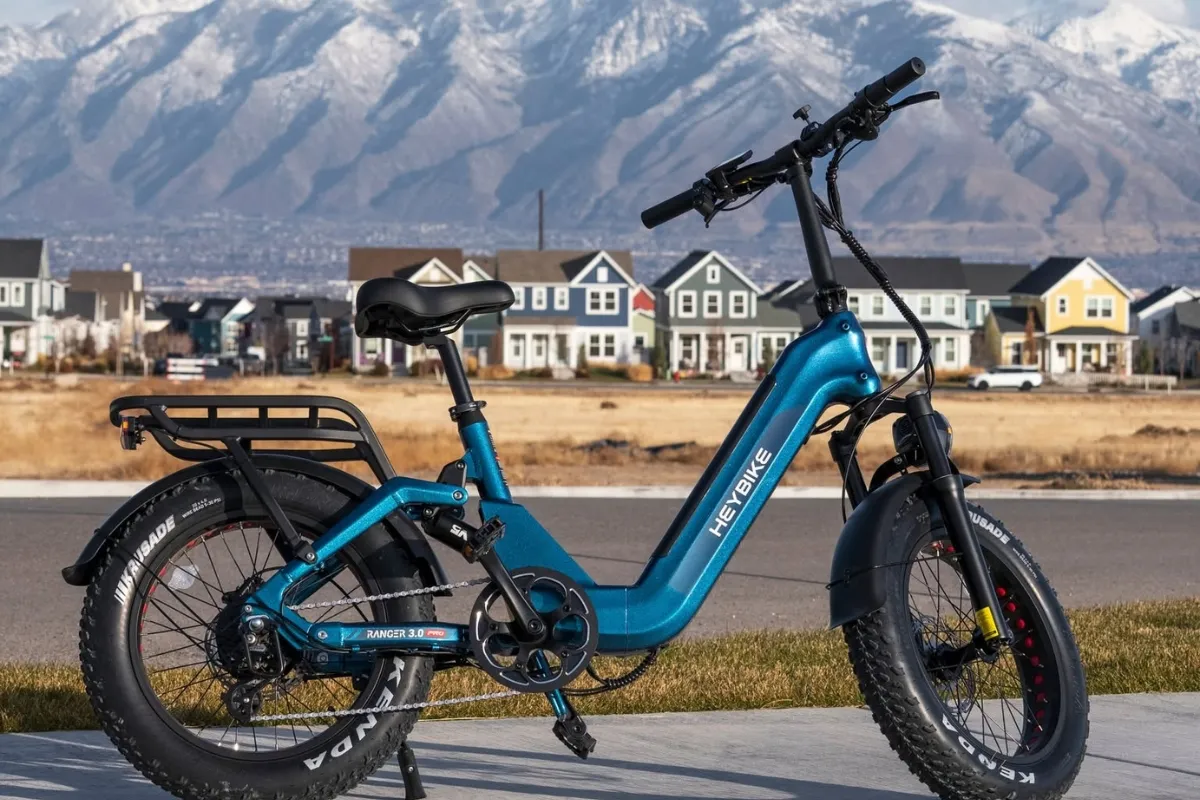
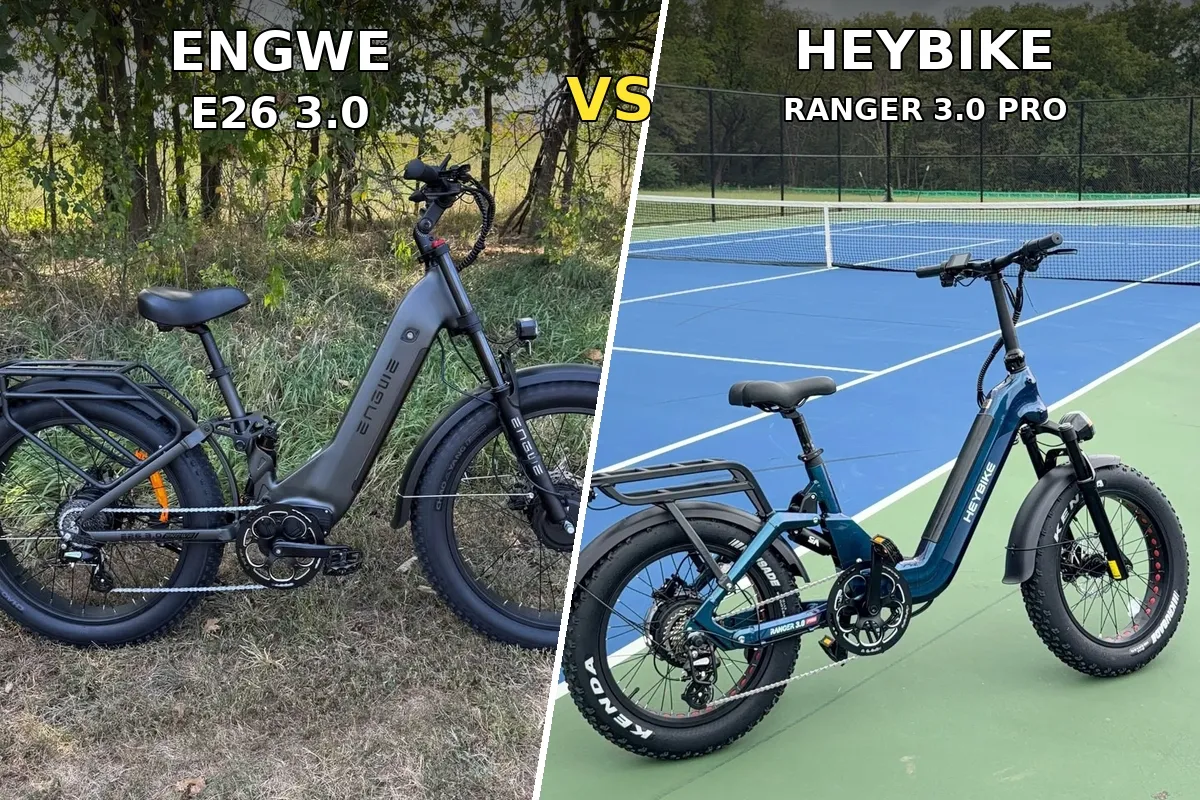
The ENGWE E26 3.0 and Heybike Ranger 3.0 Pro are full-suspension, fat-tire e-bikes built with different priorities. ENGWE combines dual motors with a larger battery. Heybike offers a folding, step-through frame and a lower published weight.
Which should you buy? Start with the problems you need the bike to solve: limited storage, vehicle loading, demanding routes, or longer rides. More power is not automatically more useful, and a folding frame only helps if it fits your space.
Quick Verdict
Consider the ENGWE E26 3.0 if you specifically want a dual-motor electric bike. Its selectable single- and dual-motor modes and 960Wh battery distinguish it from the Ranger. You will need room for a full-size bike and a way to manage its published 85.9 lb weight. Check local riding rules before purchasing.
Consider the Heybike Ranger 3.0 Pro if you need a folding fat tire electric bike. Its published folded dimensions are 41.7 × 20.5 × 32.7 inches, and its listed weight is 75 lb. It is the better option if storage space is your biggest constraint.
If you regularly carry a bike upstairs, prioritize lifting weight over either model’s feature list.
Ready to check current offers?
ENGWE vs. Heybike: Key Differences
| Buying consideration | ENGWE E26 3.0 | Heybike Ranger 3.0 Pro |
|---|---|---|
| Motor configuration | Two 600W hub motors; 1,200W combined rated output | 750W rear hub motor |
| Peak power | 2,000W combined | 1,400W |
| Battery | 960Wh | 720Wh, removable |
| Published weight | 85.9 lb | 75 lb |
| Folding frame | Not advertised as a folding model | Yes, with a step-through frame |
| Tires | 26 × 4.0 inches | Kenda 20 × 4.0 inches |
| Advertised range | Up to 76 miles single-motor or 46 miles dual-motor at PAS 1; see range note below | Up to 90 miles |
| Maximum load | 400 lb | 440 lb, including rider and cargo |
| Rear-rack limit | 150 lb | 100 lb |
| Displayed price when checked | $1,799 in the main purchase area; $1,499 elsewhere on the page | $1,399 |
For more product details, see the ENGWE E26 3.0 and Heybike Ranger 3.0 Pro product pages. Specifications are manufacturer-published. Prices were checked on October 15, 2026. Prices, promotions, and availability may change.
Folding vs. Non-Folding: Which Fits Your Space?
Storage should come before motor power.
ENGWE lists the E26 3.0 at 78.7 inches long and does not advertise a folding frame. Plan to store it as a full-size bicycle.
The Ranger folds to approximately 42 inches long, 21 inches wide, and 33 inches high. Those dimensions give you something concrete to measure against a closet, vehicle cargo area, or RV compartment.
A folding electric bike still needs a clear route for loading. Measure the narrowest opening and the final storage space. A bike might fit inside your vehicle but be difficult to maneuver through the hatch.
If a full-size bike cannot fit where you need it, the Ranger has a practical advantage. With generous garage or ground-floor storage, folding becomes a convenience rather than a requirement.
Can You Lift It?
The Ranger is 10.9 lb lighter on the published figures, but 75 lb is still substantial. Folding reduces its dimensions, not the weight you must handle.
Its removable battery lets you remove some weight before loading, though the product page doesn’t clearly specify the resulting bike-only weight.
For vehicle transport, check your rack’s per-bike capacity, tire-width compatibility, and loading method. A suitable ramp or low loading height may matter more than the weight difference between these bikes.
Dual Motor vs. Single Motor: What Do You Need?
ENGWE lets you select single-motor or dual-motor operation and switch between torque-sensing and cadence-sensing pedal assistance. Heybike uses one rear motor with torque-sensing assistance.
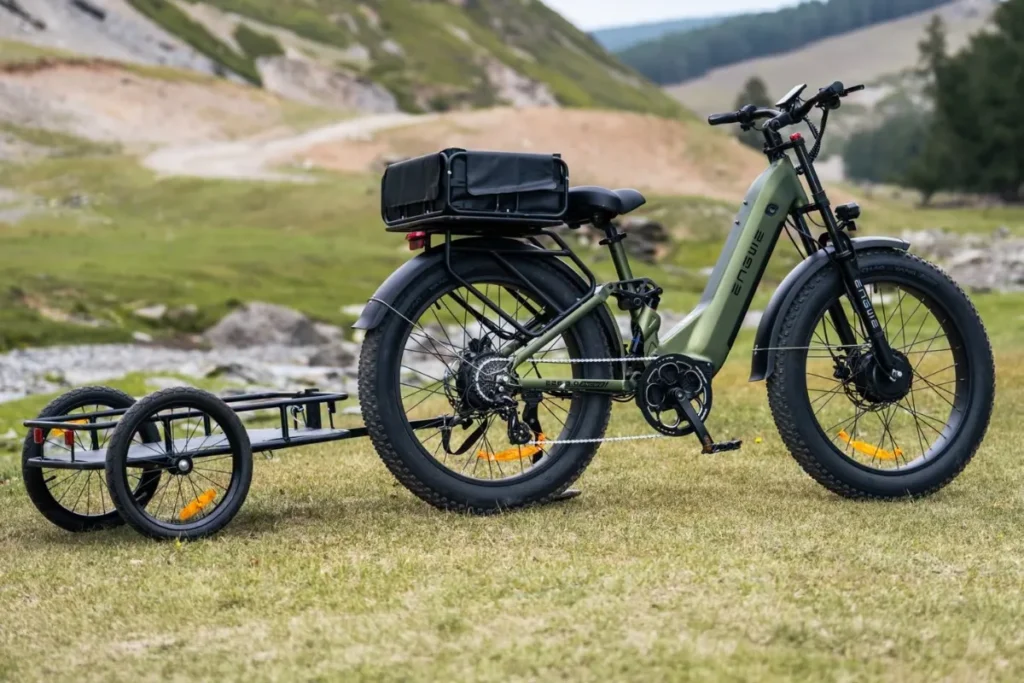
A torque sensor responds to how hard you pedal; a cadence sensor responds to pedal rotation. ENGWE lets you choose between these assistance modes, while the Ranger centers its setup on torque sensing.
ENGWE promotes its dual-motor, fat-tire e-bike for climbing and traction on challenging terrain. That explains its intended use, but higher peak wattage doesn’t guarantee better performance on every route.
Ask whether you actually want dual-motor operation. If your plans center on paved paths, errands, and occasional vehicle transport, storage and handling the bike off the saddle may matter more than a second motor.
Check Riding Rules First
ENGWE lists a 1,200W combined rated output, a 28 mph throttle speed, and a 31 mph pedal-assist speed. Before treating it as a road or trail purchase, check how your state classifies a vehicle with those specifications.
Heybike says the Ranger ships with a 20 mph Class 2 setting and can be configured for 28 mph pedal-assist with the throttle disabled.
Neither configuration guarantees access to every road, park, or trail. Check the rules where you plan to ride, and do not assume changing a speed setting automatically changes the bike’s legal classification.
Battery and Range: Which Suits Your Rides?
The ENGWE’s 960Wh battery has one-third more nominal capacity than the Heybike’s 720Wh pack. That is a meaningful equipment difference, but it does not guarantee one-third more riding distance.
ENGWE’s main performance section lists up to 76 miles with one motor and 46 miles with two at PAS 1, based on flat concrete and a 165 lb load. Another section lists 100 and 70 miles, making its official range information inconsistent.
Heybike advertises up to 90 miles, but its main specifications do not provide a directly comparable set of conditions.
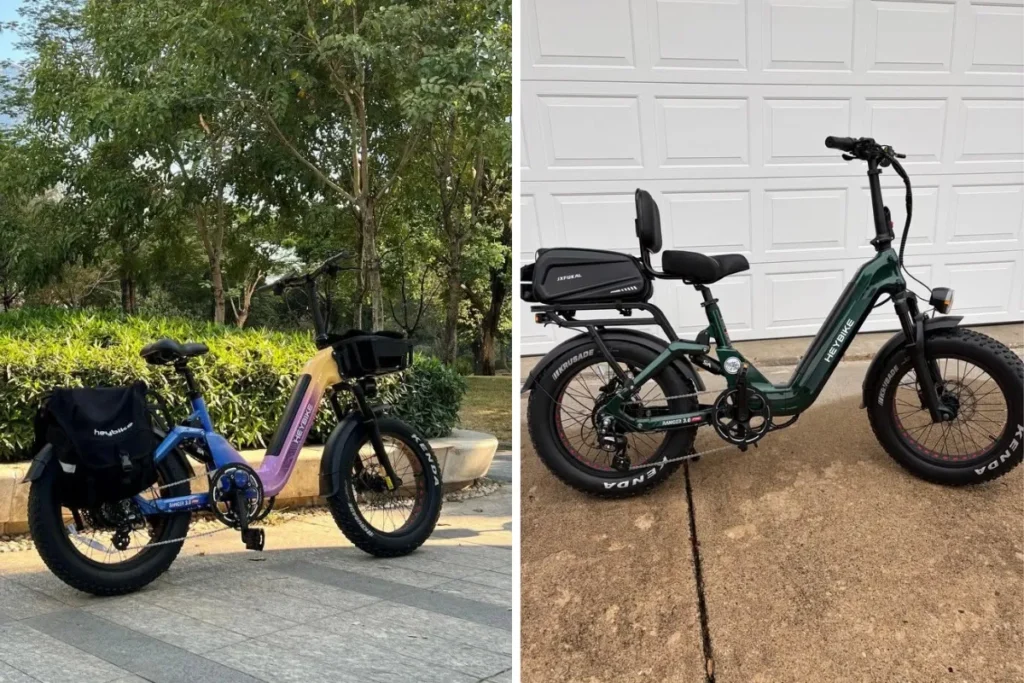
Do not choose the Ranger simply because 90 miles is greater than 76. These maximum-range claims are not an apples-to-apples comparison.
Work backward from your normal ride:
- How far is the complete round trip?
- Will you have charging access?
- How much climbing does the route include?
- Will you pedal consistently or rely heavily on the throttle?
- On the ENGWE, how often would you use both motors?
For a route you need to complete reliably, ask the brand for guidance using those details rather than relying on the maximum claim.
ENGWE lists approximately six hours to charge, while Heybike lists six to eight hours. If your storage space has no outlet, consider the Ranger’s removable battery.
Full Suspension, Fit and Cargo
Both full-suspension fat tire e-bikes combine front and rear suspension with 4-inch-wide tires. ENGWE uses 26-inch wheels and lists a 120mm front fork; Heybike uses 20-inch wheels and lists a 65mm fork.
ENGWE also lists 80mm rear suspension, while Heybike specifies an adjustable rear air shock but doesn’t clearly publish rear travel. More travel alone does not tell you which bike will be more comfortable.
Frame fit and riding position deserve equal attention. ENGWE recommends the E26 3.0 for riders from 5’4″ to 6’4″. Before ordering either bike, confirm the minimum saddle height and the measurements you need to judge whether you can mount, stop, and pedal comfortably.
Carrying Groceries or Gear?
The Ranger has the higher published total capacity: 440 lb versus ENGWE’s 400 lb. The ENGWE has the higher rear-rack rating: 150 lb versus 100 lb.
Stay within both applicable limits. Do not treat a rack’s cargo rating as approval for a passenger or child seat without explicit compatibility confirmation.
Both brands include fenders, a rear rack, and lighting. Heybike also lists NFC start, PIN unlocking, and app connectivity. Consider these conveniences after you settle on fit, storage, and riding eligibility.
Price and Value: Is the ENGWE Worth More?
The main prices shown were $1,799 for ENGWE and $1,399 for Heybike, a $400 difference. ENGWE also displayed $1,499 elsewhere, so confirm the actual offer before comparing totals.
At the higher price, the ENGWE adds a second motor, more battery capacity, larger wheels, and more published front suspension travel. Pay the premium only if those features match your priorities.
The Ranger’s folding frame may be worth more than extra motor power if it makes the difference between workable storage and having nowhere suitable to keep the bike.
Compare the final checkout total, delivery availability, and included items rather than choosing on a headline discount.
Which E-Bike Should You Choose?
| Your main priority | What should guide your choice |
|---|---|
| Limited storage | Measure your space against the Ranger’s folded dimensions. |
| Dual-motor operation | Consider the ENGWE after checking riding eligibility and storage requirements. |
| Regular vehicle loading | Assess lifting weight, loading height, and rack compatibility. |
| Longer rides | Seek route-specific range guidance rather than relying on maximum claims. |
| Frequent stair carrying | Consider lighter alternatives. |
| Cargo | Check total capacity and the separate rear-rack limit. |
Choose the ENGWE E26 3.0 because you specifically want a dual-motor electric bike and can accommodate its size, weight, and riding restrictions.
Choose the Heybike Ranger 3.0 Pro because a folding fat-tire electric bike solves a real storage or transport problem, and you can handle it when it is time to load or move it.